
“Small groups” is a phrase most people associate with a church basement or a therapy office. Something soft. Something adjacent to real work, but not real work itself.
Here is what the hard sciences say.
The US Army squad is nine soldiers. Not ten. Not twelve. Nine. Two fire teams of four, plus a squad leader. This is not a tradition. It is doctrine arrived at the way most military doctrine is arrived at: iteratively, and at cost.
The Supreme Court of the United States has ruled on jury size. Twelve works. Six is constitutional but measurably worse at recalling evidence, deliberating longer, and representing the community. The empirical research goes back to the 1970s, and most of it says the same thing: twelve is better at the one job a jury has.
The evolutionary anthropologist Robin Dunbar spent thirty years mapping the cognitive limits of human social relationships. His outer number is famous: 150 is the edge of people you can maintain meaningful contact with. What is less famous is the inner architecture. Fifty close friends. Fifteen people you could call at 2 a.m. Five people whose problems already feel like yours. The exact numbers are contested. The layered architecture is not.
The number keeps showing up. The twelve disciples. The twelve-step meeting. The platoon. The writers’ room. The jury. The squad. The pod.
And corporate America, for reasons that appear to be entirely administrative, decided sometime in the twentieth century that a “team” could be any number of people you could fit in a conference room or on a Zoom grid. Fourteen. Twenty-two. Forty-seven, if you are on an all-hands. We scaled the word “team” until it stopped meaning anything, and then we wondered why nobody felt like they belonged to one.
This is a piece about what the science actually says. And what it is costing you to keep ignoring it.
The number
Between six and twelve. That is where the research converges.
Below six, the group gets brittle. One person out sick and the dynamic collapses. There are not enough voices to generate real disagreement, which is where good thinking actually comes from.
Above twelve, something different breaks. People stop tracking each other. They stop finishing their sentences because someone else already started. Contribution becomes optional, and quietly, a lot of people opt out.
This is not a preference. It is a cognitive ceiling. Dunbar’s data suggests the human brain is running a background process that tracks everyone in the room: their status, their mood, their likely next move. That process starts to fail somewhere north of twelve, depending on the person.
You can override it with hierarchy. That is what a meeting is. But a meeting is not a team. A meeting is a room where decisions get announced. A team is a unit that makes decisions together, and the ceiling for that is twelve, probably ten.
What happens above the ceiling
In 1913, a French engineer named Maximilien Ringelmann measured how hard people pulled on a rope when they pulled alone, and how hard they pulled when they pulled in groups. The finding was durable enough to get its name attached. The Ringelmann Effect: the larger the group, the less each individual pulls. Not because they are lazy. Because they cannot tell if their effort matters.
This has been replicated so many times it has become boring. Latané and his colleagues named a broader version in 1979: social loafing. Bystanders do not intervene when there are too many of them. Brainstorms produce worse ideas when the room is too big. Juries of six are worse than juries of twelve at the one job a jury has.
The mechanism is diffusion of responsibility. If it is not clearly yours, it is not clearly anyone’s. Scale the group and you scale the diffusion.
This is what is happening on the cross-functional team of nineteen that is not shipping. It is not a talent problem. It is a geometry problem.
What happens when you get it right
Inside the ceiling, the dynamics flip.
Trust builds because repetition becomes possible. You see the same ten faces every Tuesday, and by week six, you know who is carrying something heavy. That is not a soft observation. That is what the literature on psychological safety is actually measuring: the conditions under which a person will say the thing they are nervously thinking.
Accountability stops being a performance review and becomes a quiet conversation. Disclosure becomes survivable. People stop managing their image and start managing the work.
Gallup’s research on workplace engagement has one item that correlates with performance more strangely than any other: I have a best friend at work. Executives hate this item. They have pushed back on it repeatedly. It keeps predicting retention, productivity, and customer satisfaction, because the thing it is actually measuring is whether you are embedded in a unit small enough for friendship to happen.
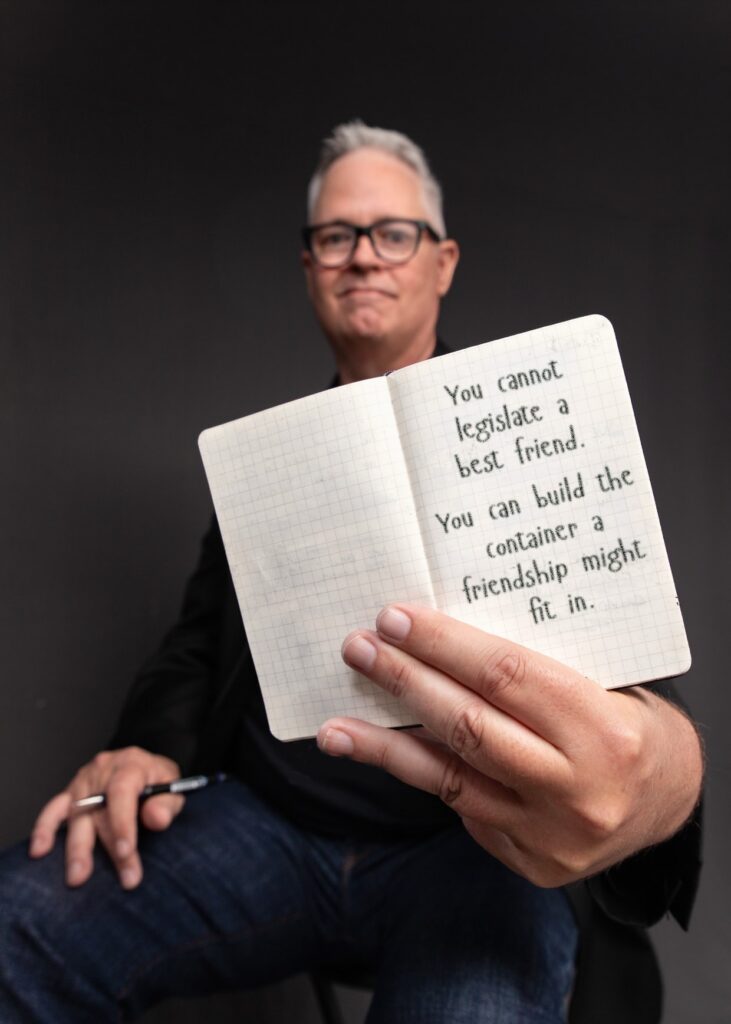
You cannot legislate a best friend. You can build the container a friendship might fit in. A small group is that container.
Why business keeps getting this wrong
The org chart is a geometry problem, not an anthropology problem. The people drawing it are optimizing for reporting lines, headcount efficiency, and conference room capacity. They are not optimizing for the thing human beings evolved to do.
A “team of 22” is a convenience for the person managing it. It is an impossibility for the people inside it.
The fix is not to dissolve the team of 22. It is to stop pretending it is a team.
Your first move
1. Count your real teams. Not your org chart. Your actual units: the people who see each other weekly, make decisions together, and know each other’s work. If any of them are over twelve, you have a structural problem masquerading as a people problem.
And here’s a gift for you… TWO! MORE! MOVES!
2. Build the container. A small group in a business context has a standing meeting, a recurring agenda, and a membership you do not change casually. Six to ten people. Ceiling of twelve. That is it. The magic is in the repetition.
3. Name what it is for. A small group without a purpose is a support group. A small group with a purpose is a team. The purpose can be a project, a practice, or a question, but it has to be named, or the group will drift into performing collaboration instead of doing it.
“Small groups” still sounds soft. That is a marketing problem, not a science problem. The US Army is not soft. Juries are not soft. The twelve disciples, whatever you believe about them, were not running a support group.
What these groups have in common is not their subject matter. It is their size. And the reason the size keeps showing up (in the military, in the courts, in our evolutionary history, in the meetings that actually change people’s lives) is that human beings are built for it.
So look at the org chart again. Count past twelve anywhere and you are not looking at a team. You are looking at a word on a slide.
The good news is that the fix costs nothing. No software. No consultant. No reorg announcement with a code name. Six to ten chairs, the same faces every week, and a named reason to be in the room.
You have had the science for a hundred years. The Army has it. The courts have it. Your people are waiting for you to catch up.
A squirrel worth chasing
Ringelmann ran his rope experiments in 1913 with agricultural students, and for decades almost nobody noticed. The paper sat in a French agronomy journal until researchers rediscovered it seventy years later and realized an engineer studying farm labor had quietly documented one of the most durable findings in social psychology. The man was measuring oxen and horses too. The humans just happened to be the most interesting animals in the study.
Let’s take care of each other,

Oh, and PS… why, yes! It is kind of ironic that we have five decades of research on the right size for a jury and a standing national shouting match about the size of the Court it reports to. It was not lost on you. I knew you were awesome.