
The HQ Method is how you raise your human quotient.
Not a motivational speech. Not a consultant’s binder. A structured, ongoing implementation built around the way real behavior change actually happens: gradually, deliberately, and with your managers at the center of it.
This system exists because most culture programs don’t work.
Not because the people behind them don’t care. Because they’re built around events (retreats, team building days, speakers, trainings, assessments) instead of habits.
Habits form through repetition. They’re reinforced by environment, recognition, and practice. They’re measured so they can improve.
The HQ Method was built on that research. Every element — the Pillars, the Beacons, the Tools, the Score — exists because it reflects how human beings actually change.
Built on how people actually change.
~66 days
Roughly how long a new behavior takes to become automatic.
Culture change is habit change, and habits form on a timeline, not in an afternoon.
Lally et al., 2010
Spaced beats massed
Short, spaced, varied repetition outperforms one long session every time it’s measured.
The forgetting curve is real, and it’s been replicated for more than a century.
Ebbinghaus · Cepeda
Variable beats fixed
A rotation of changing tools is a variable-reinforcement schedule.
The habit it builds is more durable, and harder to lose, than any single repeated exercise.
Ferster & Skinner
This is why the method spaces the work out and rotates the tools instead of repeating one. Each new tool reopens curiosity, the mind’s response to an information gap, and quietly reinforces the ones before it. The science isn’t decoration. Every choice in the method follows it on purpose.

It needs more care.
It needs better questions.
It needs clearer models of behavior.
Where will they come from?
Three distinct pillars. One coherent system.
Everything in the HQ Method connects to one of three Pillars. They’re not stages. They’re simultaneous conditions, each one reinforcing the others.
Belonging
People don’t give their best effort to a place they don’t feel part of.
Belonging isn’t a team-building exercise. It’s a daily condition built through consistent manager behavior, honest communication, and an environment where people feel genuinely seen.
When Belonging is strong, everything else gets easier.
Betterment
Stagnation is quiet. People don’t announce it when they stop growing. They just stop caring.
Betterment is the Pillar of deliberate development. It’s what happens when managers invest in their people’s growth with structure, not just intention.
When people are growing, they stay. When they stay, the culture compounds.
Breakthrough
This is what Belonging and Betterment make possible: Your company becomes a perpetual positive momentum machine.
Breakthrough is the Pillar of results — unexpected progress, creative problem-solving, and performance that surprises even the people producing it.
It isn’t forced. It’s the natural output of a culture that’s working.
Beacons give your culture a North Star to navigate by.
Before tools can work, the culture needs orientation. Beacons are the foundational elements every team needs in place, and not as slogans, but as living, practiced commitments.
Purpose
Why this company exists beyond profit. When people understand it (and believe it) work means something.
Vision
Where you’re going. Specific enough to guide the company. Shared enough to pull people in the same direction.
Values
Not a list on the wall. Behaviors that are modeled by company leadership, practiced daily, and rewarded explicitly.
T3 Rewards
A recognition framework built around Time, Talent, and Treasure, because people don’t all feel valued the same way.
The T3 Rewards field guide
Here’s what to do when someone says you can’t reward people regularly.
One page. Free. No email.
The Tools
Business schools have traditionally focused on maximizing shareholder value, often at the expense of the people doing the work. We looked elsewhere. Since 2004, we’ve been studying the invisible heroes and agents of positive change who lead with love and model the behavior they want to see in others.
Our tools come from therapy sessions. Doctor visits. Classrooms. Locker rooms. Church basements. Tools that helped people change for the better — in the hardest settings imaginable — adapted for the workplace.
Every Process Guide in the HQ Method was built on that research. Not on a case study. Not on a TED Talk. On what actually works when the stakes are real and the people matter.
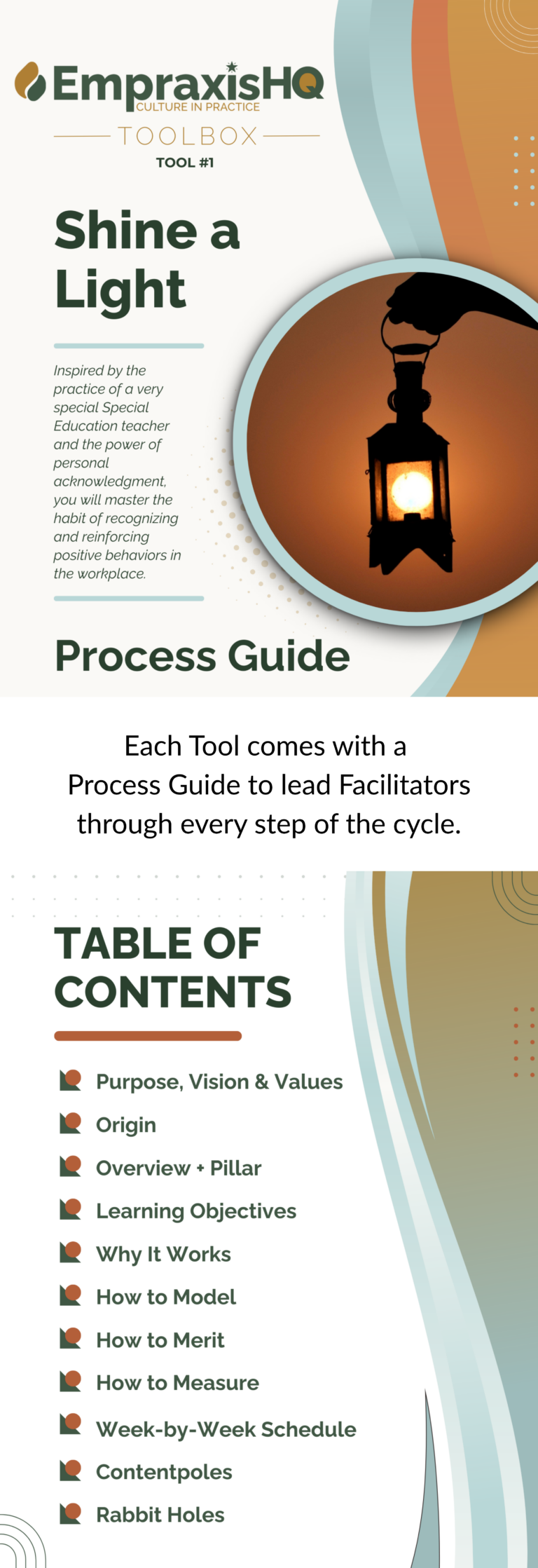
Process Guides are the working tools of the HQ Method. Each one is a structured practice with a clear origin, a defined purpose, and a way to measure whether it’s working. They’re not handouts. They’re not homework. They’re repeatable manager behaviors that become part of how your culture operates.
One tool at a time. Practiced, reviewed, and built on before the next one arrives. That isn’t slow. That’s how change sticks. No single tool installs a habit. The rotation installs the culture.
“Change requires motivation. Motivation only comes from two places: fear or love. The choice is yours.”
Becky Bailey, Ph.D.
Not romantic love. Not drum circle rainbow moonbeamy unicorn love. Not the love of Valentine’s cards or wedding vows. The love of parents who don’t give up. The love of coaches who demand your best. The love of teachers who always find a way.
18 Minutes a week
per employee. short, spaced bursts, not one long block.The objection is always time. This is the answer. Eighteen minutes is the dose the science supports, not a compromise we made to sell it.
The tools are built to replace what isn’t working, not pile onto it.
Set that against what a disengaged culture already costs you, in turnover, lost momentum, and the service failures that follow. Eighteen minutes a week is the cheapest line item you have.
You can’t improve what you don’t honestly measure.
The HQ Score is a 57-question assessment built around the three Pillars. It produces a weighted score out of 200 points, and it’s administered twice a year so you can see movement, not just a snapshot.
Inside every HQ Score is The Shadow: the gap between how leadership perceives the culture and how employees actually experience it. That gap is where the real work begins.
Most companies find the first score humbling.
Every company finds the second one motivating.
Measure. Model. Merit.
The three ingredients necessary for change are simple to understand, but they aren’t necessarily easy to adopt.
Measure
What you track improves. The HQ Score gives you a number that moves — so you know when it’s working, and you know when to adjust.
Model
Culture starts at the top. Leaders have to visibly practice what they’re asking of their teams. Not perfectly — consistently.
Merit
What gets recognized gets repeated. The HQ Method builds explicit, fair, human recognition into the rhythm of your culture as an everyday practice.
You now know what the system looks like.
Let’s talk about what it looks like for your company. Every engagement starts with a conversation about where you are, what’s costing you, and whether the HQ Method is the right fit.