
You have been told, most of this year, that the machines are finally coming for everything. Your job. Your company. The livelihoods of every person whose name is on your payroll. That is the story arriving just in time for the country’s two hundred and fiftieth birthday: Artificial intelligence will do what you do, faster and cheaper, and the American worker is a museum exhibit waiting on its plaque.
This country has heard that eulogy before.
It came with the power loom. The telegraph. The tractor, the assembly line, the mainframe, the spreadsheet. Two hundred and fifty years of astonishing machines, and every wave arrived with an obituary for human work. Every obituary got the same thing wrong.
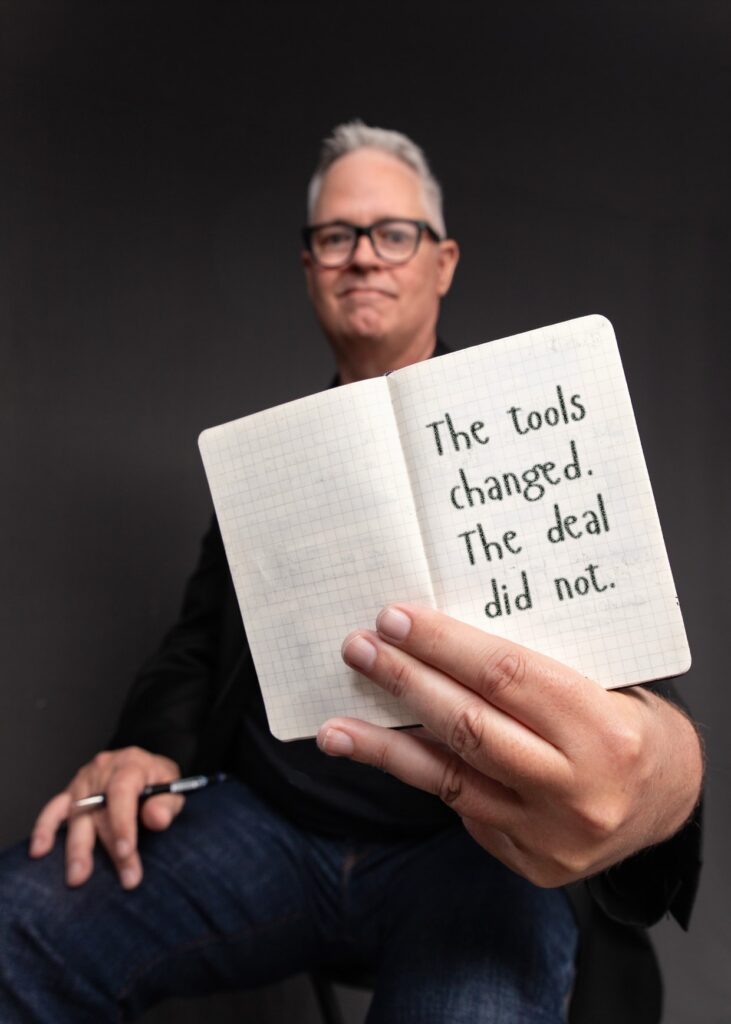
The tools changed. The deal did not.
Here is the deal, signed in 1776 and still in force:
You are free to work how you choose, build what you want, and run your company any way you see fit, provided you are willing to own the consequences.
That is independence. Ends in e-n-c-e.
You live that deal every single day. Some of you sign the fronts of paychecks. Some of you sign the backs. You open the shop, run the route, plant the crop, heal the pet, stay late so somebody else doesn’t have to, answer the phone with the company’s name in your mouth like it’s your own. Because it is.
You are the independents. Ends in e-n-t-s.
This is your birthday too.
You know what refused to change while everything else did?
Decency.
Kindness to a neighbor. Showing up when someone’s truck won’t start or their basement floods. The handshake that still means something in towns where everybody knows whose handshake doesn’t. The machines took the plowing, the typesetting, and the long division. Decency stayed, because decency was never a task. It is a choice, made daily, by people willing to own what it costs.
And if you think that’s nostalgia talking, ask the world. Over a million visitors flew in for the World Cup this summer, and our feeds filled up with them: fans from Glasgow and São Paulo and Egypt, half-stunned on camera, reporting that Americans keep feeding them, hosting them, and driving them to matches when the ride never came. A tourism researcher told ABC News why these are the clips everyone remembers: people remember people more than places. Two hundred and fifty years in, the people still hold up.
“What gets measured gets managed.”
Which brings us to the part where I stop waving the flag and show you a number.
For a hundred years, American business has measured three things: revenue, profit, and benefit to shareholders. And precisely those three things grew, spectacularly. That is no accident. What you measure is what you model, and what you model is what you merit. The system worked exactly as designed. The design was simply incomplete.
Raj Sisodia, David Wolfe, and Jag Sheth tested the incompleteness. For Firms of Endearment (second edition, 2014), they identified companies selected for how they treated every stakeholder: employees, customers, suppliers, communities, and shareholders. The publicly traded firms in their sample returned 1,681 percent from 1998 to 2013. The S&P 500 returned 118 percent over the same fifteen years. John Mackey and Sisodia carried the same evidence into Conscious Capitalism. Companies that counted more than money made more of it.
If you measured belonging, belonging would grow. If you measured betterment, betterment would grow. If you measured breakthrough, you would get more of it than you know what to do with. And the revenue, the profit, the benefit to everyone with a stake in your company? Read the paragraph above one more time.
One more founding-era story, because this one is almost unfair. Decades before the Declaration, a young Philadelphia printer named Benjamin Franklin drew a chart in a little pocketbook. Thirteen virtues down the side, days of the week across the top, a black mark for every lapse. One virtue per week, in rotation, then begin again. The most famous American of the founding generation ran a culture program with a membership of one. He measured the behavior. He modeled the behavior. He kept score until it held. Franklin was measuring, modeling, and meriting in a notebook he could fit in his coat before the nation existed.
So no, I am not spending this weekend worried about the machines.
I am thinking about the owners reading this before the crew shows up. The ones who lie awake over payroll, knowing the names on it are parents with families depending on them. The ones who feel alone with that weight.
And I am thinking about the crew. The ones who show up in the heat, in the dark, and on the day after a funeral. The ones who know the route by heart, the customer by name, and the exact sound the machine makes right before it quits. The ones who carry the other end of that weight.
Two hundred and fifty years of relentless change, and one kind of person is still standing: the one willing to own the consequences. That is you. The birthday is yours. Celebrate accordingly.
Your first move
Pick one thing you want more of that has never once appeared on your P&L. Belonging works fine. This week, carry a notecard and make a tally mark every time someone on your team helps someone else without being asked. Do it quietly for two weeks. Then watch what happens when they find out you were counting.
A squirrel worth chasing
Franklin’s chart, in his own words, in a book he never finished: The Autobiography of Benjamin Franklin, free at Project Gutenberg. The virtue project starts in Part Two. Bring a pencil.
Let’s take care of each other,
Oh, and PS… The 4th is also Sara’s birthday. She raised three remarkable daughters on her own, and her reward is a partner with the energy of a golden retriever all jacked up on Mountain Dew. Belonging, betterment, breakthrough: she was modeling all three long before I gave them capital letters. Happy birthday, Sara. I love you.