
Your vision statement isn’t working.
I don’t mean it’s not inspiring enough. I don’t mean it needs better verbs, a punchier tagline, or to be printed on nicer paper.
I mean your brain is filing it in the wrong folder.
Here is what the science says about seeing the future.
In 1995, a neuroscientist named Alvaro Pascual-Leone, then at the National Institutes of Health, taught two groups the same five-finger piano exercise. One group practiced on a real keyboard, two hours a day, five days running. The other group only imagined practicing. Same schedule, same hours, no instrument. When he mapped their motor cortex afterward, the changes were nearly identical. The mental group had physically rewired their brains by thinking.
A decade later, Harvard psychologist Daniel Schacter proved the companion finding at a different layer. The hippocampus, your memory center, is equally active when you remember the past and when you imagine the future. Schacter called it constructive episodic simulation. The plainer version: your brain builds tomorrow out of the same parts it uses to rebuild yesterday. This is why fiction feels real. Why rehearsal works. Why people with damage to the hippocampus lose not only their memories, but their ability to picture any specific future at all.
One more finding, and then the turn.
NYU psychologist Gabriele Oettingen has spent thirty years studying what positive thinking actually does to motivation. Her answer is that pure positive fantasy, imagining the outcome you want and dwelling on how good it would feel, is worse than nothing. The brain gets a hit of reward from imagining success and quietly powers down. In her studies, the dreamers consistently underperform the realists, and not by a little.
What works is what she calls mental contrasting: imagine the outcome, then imagine the obstacle standing in front of it, then imagine what you’ll do when the obstacle arrives. Wish. Outcome. Obstacle. Plan. She abbreviates it WOOP. In clinical trials it has produced significant, replicated effects on weight loss, physical activity, academic performance, relationship quality, and recovery from illness. Not because it’s magic. Because it’s how the brain actually plans, not as fantasy, but as rehearsal with friction.
Three findings. One thesis.
Your brain does not meaningfully distinguish between vividly imagined experience and actual experience. And it files what you tell it based on the tense you tell it in. “I will build this” lives in the prediction folder, next to daydreams and weather forecasts. Cheap. Easily discarded. “I built this” goes somewhere else. Somewhere it has to be defended.
The tense is the setting.
The planning problem
Almost every strategic planning exercise in business uses the same grammar.
By 2035, we will have become the leading provider of X.
In five years, we will have built a culture of Y.
Every one of those sentences is grammatically future and neurologically weightless. You wrote a forecast. The brain shelved a forecast. And a forecast is a thing you are allowed to be wrong about, so it asks nothing of you between now and 2035.
Watch what happens when you turn the exercise around.
Stand ten years out. Look back. Don’t tell me what you will do. Tell me what you did. What you built, who you became, and what you had to beat to get here. Write it the way you’d tell it to someone at a reunion, in the past tense, because the past tense is the only tense your brain files under real.
Then do it again at twenty months. And again at thirty days.
Three horizons, three jobs.
The ten-year view sets identity. It answers who the company became, not what it hit. Far enough out that the details blur and only the character survives, which is the point.
The twenty-month view sets strategy. Close enough to be concrete, far enough to require more than the obvious next move. This is where the accomplishments get specific and the obstacles get named, because Oettingen’s data says an outcome without its obstacle is a daydream wearing a suit.
The thirty-day view sets behavior. It answers what you did this month, which is another way of asking what you do tomorrow morning. It is where a ten-year identity finally touches a Tuesday.
For ninety minutes, they are not forecasting. They are remembering something that has not happened yet, which is a stranger, more useful, and more durable mental state than any planning exercise has ever put them in.
The plans you make in that state get kept.
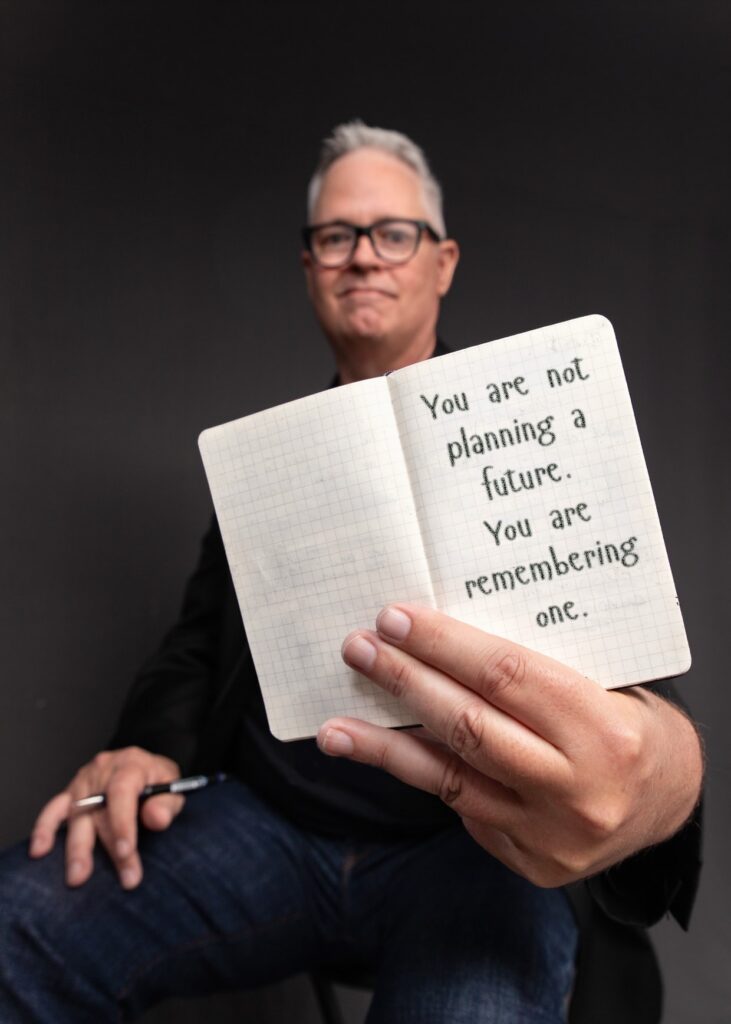
Remember forward.
Your vision statement isn’t working because your brain isn’t reading it the way you wrote it.
You wrote a forecast. Your brain needed a memory. That gap, the gap between the tense you used and the tense that would have lodged, is why every strategy deck from every offsite you’ve ever attended is sitting in a folder somewhere, unread, unfinished, not defended.
The fix is not to try harder on the next forecast.
The fix is to stop forecasting.
Travel ten years forward. Look back. Tell us what you accomplished, and what you had to beat to earn it. Do the same at twenty months. Do the same at thirty days. Write all of it in the past tense, because that is the tense your brain files under real.
The organizations that figure this out won’t describe themselves as strategic. They will describe themselves as paying attention to how memory actually works, and using it.
You are not planning a future. You are remembering one. The work is to get specific enough about the memory that your brain goes looking for the pieces.
Your first move
Take your existing ten-year vision, the one sentence you already have, and add one more sentence: the obstacle you had to beat to get there. That’s it. Outcome plus obstacle is the whole mechanism. Most visions have the first half and skip the second, which is exactly why they read like brochures instead of memories.
A squirrel worth chasing
The past tense may be the oldest technology we have. Anthropologist Polly Wiessner spent forty years with the Ju/’hoansi Bushmen of southern Africa, and in 2014 she published something quietly astonishing: She compared 174 daytime and nighttime conversations and found they were not the same species of talk. Day talk was economic. Practical. Who did what, who owed whom, whose behavior needed correcting. Then the sun went down, the fire came up, and the talk turned to story. Not gossip. Story, in the past tense, often about known people, carrying the workings of entire institutions with almost no formal teaching. A culture handed itself forward, one remembered night at a time. When we ask you to write your vision as a memory, we are not being clever. We are using the format the species has trusted for four hundred thousand years.
Let’s take care of each other,
Oh, and PS… Notice we didn’t capitalize “vision statement.” The people who capitalize it are usually the same ones who framed it, hung it in the lobby, and haven’t read it since. Yours should be lowercase and load-bearing.