
When a powerful new tool arrives, and one has, owners tend to split into two camps, and both feel like wisdom from the inside.
The first camp recoils. They distrust the tool, romanticize the way things were, and quietly hope the whole thing blows over. Call them the cabin-dwelling abacus romantics: convinced that the human and the machine are enemies, and that virtue means refusing the machine. The second camp lunges the other way. They see the tool as a way to need fewer people, and they start counting the humans they can remove. One camp fears the future. The other strip-mines it. And the whole of this series has been quietly walking toward the door both of them missed.
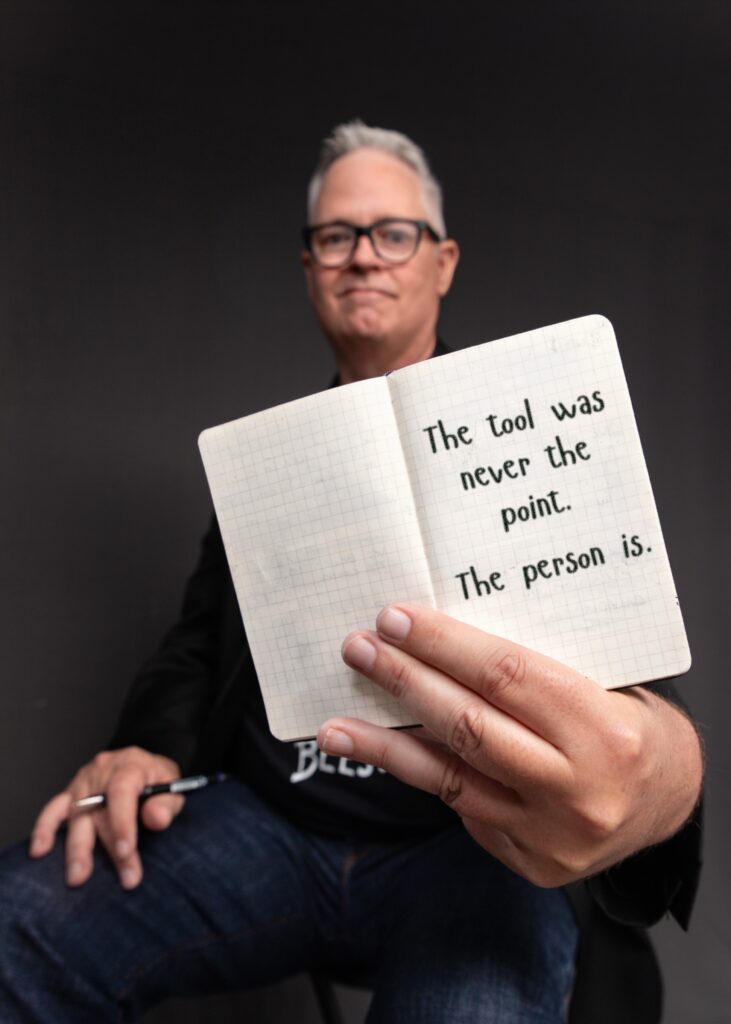
Here is the conviction, and it is the one all the others were built to hold up. The tool is never the point. The person is. You use the tool to develop the people, not to replace them and not to hide from them.
We have the cleanest proof of this from the exact place the machines first won. In 1997, a computer named Deep Blue beat Garry Kasparov, the strongest chess player alive, and the world declared the human era over. Kasparov did not go live in a cabin, and he did not concede that people were now obsolete. He did something better. He invented a new game, advanced chess, where a human and a computer play as one team, and then he watched what happened when those teams competed. What he found should be printed on the wall of every company nervous about AI. A weak human player, paired with a machine, running a better process, beat a strong computer alone. And more remarkably, that same weak-human-plus-machine team beat a strong human paired with a machine who ran a worse process. In 2005, the freestyle tournament made it undeniable: two amateurs with three ordinary laptops beat grandmasters with supercomputers.
Sit with what that means, because it is the whole argument. The winning ingredient was not the strongest machine. It was not even the strongest human. It was the process, the way the people were developed and organized around the tool. Give ordinary people a good tool and a great practice, and they beat extraordinary people with a good tool and a sloppy one. The machine is an amplifier. What it amplifies is the quality of your people and the practice you have built around them.
Do more with more.
Which brings us to the choice sitting on every owner’s desk right now. The efficiency these new tools create is real, and you get to decide what to do with it. You can use it to keep more for yourself: cut the roles, thin the ranks, widen the margin, and call it discipline. That is the easy, obvious, everyone-is-doing-it move, and it is the slow strip-mining of the one advantage a machine cannot copy. Or you can use it the other way. You can take the room the tool gives you and spend it growing every person in the building into something they could not have been before. Stop trying to do more with less. Do more with more.
That is not sentiment. It is the through-line of all ten of these. See the gap, because your people are worth the honesty. Go to the floor, because that is where they actually live. Count the culture, model the behavior, mean the values, uncover them, build the small rooms, keep the practice. Every one of those convictions points at the same thing: the human beings in your company are the asset that appreciates, the moat that deepens, the one competitive advantage that gets more valuable exactly as the machines get better, not less. That is the Human Quotient. That is HQ. It was always the people.
The machines are coming. Some companies will use them to become smaller, colder, and briefly more profitable. Others will use them to become the kind of place a person is lucky to work, and those are the companies that will still be standing, and still be loved, on the far side of all this. You already know which one you want to build. You have known since the first gap. This is just the way of seeing that lets you build it.
Your first move
Name the one task you are most tempted to hand entirely to a machine so you can remove a person. Now flip the question. Ask instead: if I gave this tool to that person, what could they do that neither of them could do alone? Then try it, once, on purpose. You will have run your first centaur, and you will have felt the difference between using a tool to shrink your company and using it to grow your people.
A squirrel worth chasing
You have been misusing a word your whole life. When someone rejects new technology, we call them a Luddite, and we mean it as an insult: a fearful crank swatting at progress. The real Luddites were nothing of the kind. They were skilled English textile workers in the early 1800s, many of them expert machine operators themselves, and they were not against machines. They said so plainly, opposing only the “machinery hurtful to commonality”, the machines factory owners used to replace skilled people with cheap child labor, drive down wages, and pump out shoddy goods. They even championed one machine that counted threads to prove the quality of their work. They loved the tools that developed people and smashed the ones used against them. Their whole movement was a single, reasonable sentence: use the tool to lift the worker, not to discard them. Two hundred years of bad branding turned the most sensible position in the room into a slur. The cabin-dwelling abacus romantic is a myth. The real Luddite was asking for exactly the thing this whole series has been about.
Let’s take care of each other,

Oh, and PS… it’s Moneyball… but for AI…
@thatsmyboyjacob It’s about reducing these people down to just a number #corporatehumor #layoffs #employee #parody #moneyball ♬ original sound – Jacob Capozzi